FOSDEM 2012
In a few hours, I'll be flying to Brussels with
Ivan, for a new edition of
FOSDEM, undoubtedly the best Free Software
conference in Europe.
I'm looking forward to hang out with Debian, GNOME and #dudes
people, as well as to explore some other quiet and cool spots in the city with
our hosts Raül and Vir.
I'll probably be around the CrossDistro and CrossDesktop rooms most of the
time, but before that I'll be at the Delirium café not long after landing in
Brussels.
For someone who doesn't enjoy cold weather that much, this is
going to be a
special edition…
oh dear, -10℃, this is fucking crazy!

13:05 |
[] |
# |
(comments: 0)
FOSDEM 2011
When I returned from the
first FOSDEM edition I
attended, I wrote that I had liked and enjoyed that weekend in Brussels so
much, that this conference had probably become a “must”.
It seems I was right. Five years later, I'm delighted to say

I'm happy to meet so many friends from the
Debian,
GNOME or
GNU projects, and enjoy the kindness of
our hosts in Brussels, Raül and Virginia. And I'm looking forward to the
awesome beer, the excellent talks and discussions, and that unique FOSDEM
atmosphere that makes this so special. This year, FOSDEM has the bonus of
being able to enjoy the Debian “squeeze” 6.0 release as it happens, with many
of the people who made it possible, and celebrate this on Saturday night.
See you there!
22:45 |
[] |
# |
(comments: 0)
De mar a mar, hiking across the Pyrenees
Two weeks ago, Maria and I completed
one of our dreams
when we arrived in Cap de Creus, where the Pyrenean range sinks in the
Mediterranean. To get there, we walked hundreds of kilometres during a month,
crossed dozens of steep valleys and enjoyed one of the richest experiences
of our lives.
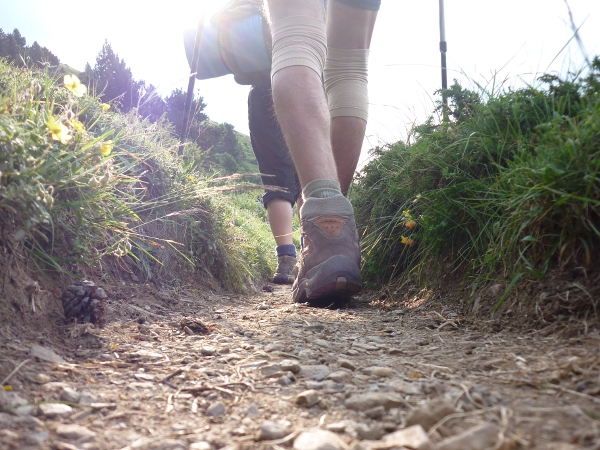
We managed to complete this challenge without facing major problems or
pains, and after the first five our six days, our legs seemed to have
gotten used to the daily effort and it started to be easier and easier.
Our morale kept growing as days passed and we advanced east. When I
started walking on a cold and rainy morning in Hondarribia, after barely
no rest in the night bus to Irún, I thought for myself that it was
improbable that we'd manage to get anywhere near Catalunya, that one of
us would get injuried way before, or we'd just give up and go for the easy
beach vacation in the Basque Country.
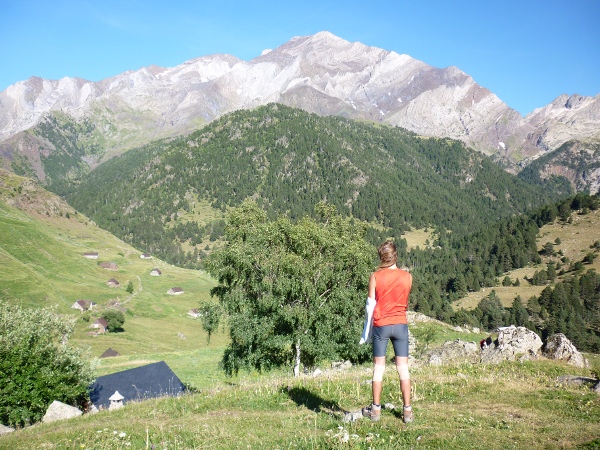
Biadós refuge, under Posets
But we didn't, and after a somewhat painful start, with our boots soaking
wet during the stages that crossed the enchanting Selva de Irati
which ended up with me getting the biggest blister I've ever seen, we
started to walk farther every day, extending the stages when we
felt strong after reaching their official end. When we crossed from
Nafarroa to Aragonese territory, the mental wall that I had built over the
toughest stages in our quest started to fall apart. Days later, we found
ourselves climbing down to Pineta, leaving Ordesa behind and enjoying a
feeling that our adventure could not go better. The weather had been
perfect for over a week and our legs and back were strong to go all over
the way to the sea.
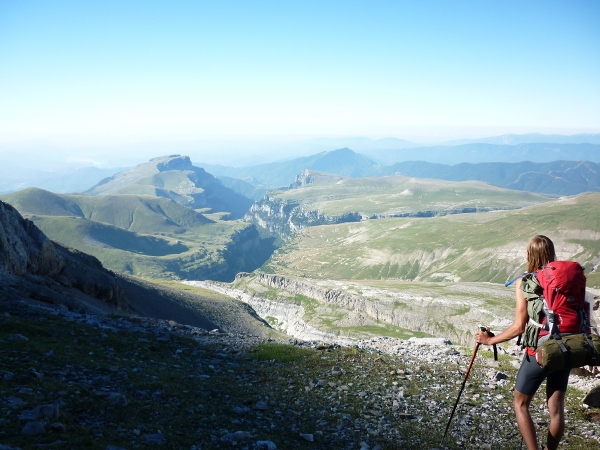
Cañón de Añisclo, on our way to Pineta
When we finally saw that huge blue stain on the horizon, the day before
getting to the last mark, we got really excited. We had made it, but as we
walked towards the cape, happiness slowly got mixed with melancholy. An
unforgettable adventure was about to end, and we didn't want to face our
return to the city and our routines. It had been many days surrounded only by
awesome landscapes, and living without watches, with only sunlight and
weariness marking the time to get in our sleeping bags.
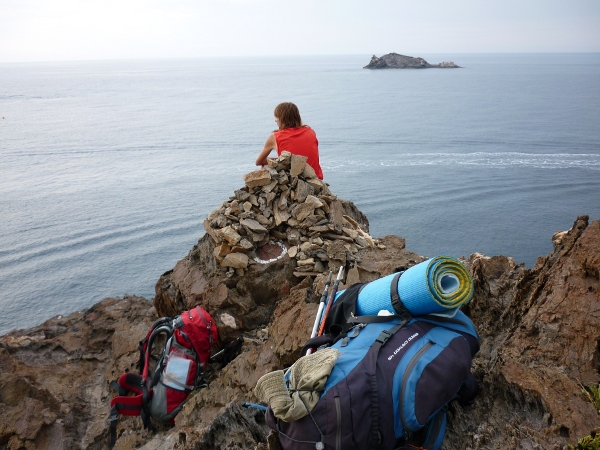
At the very last red and white mark of our journey
We've had plenty of time to meet great people. Starting with
the Navarrian brothers we met in the early stage, which provided us with a
good pace to follow while our leg muscles were still building up; or Kike
and Ana, who drove from Pamplona to visit us during the first Aragonese
stages (thanks for the supplies!). Tomàs and Roger, young hikers from
Mataró, surprised us with their maturity and experience as mountaineers;
we had the pleasure to join forces during four days, walking a really cool
variant through the Infiernos and Collado del Letrero
which avoided going through the ghost city of Panticosa. Roger and Tomàs,
we really hope to meet you soon! Andreu, Manel, Ghandi and Gaŀla visited us
at the Vall de Núria and were unlucky to suffer a frightening
hail and thunder storm when they left our shelter on their way back to
their car. Thanks! All of you have been a very special part of our
experience!
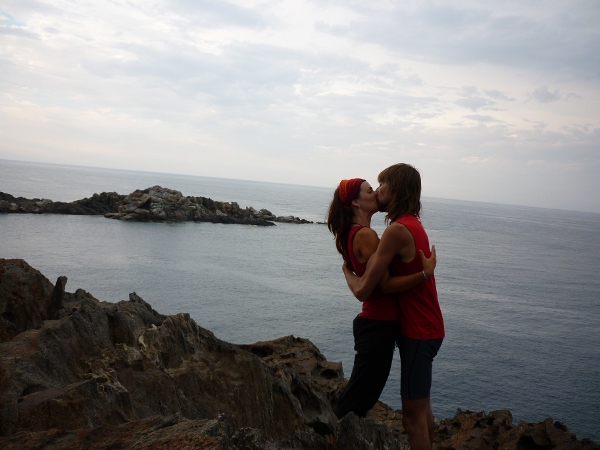
This adventure through GR 11 has been incredibly positive for us for
several reasons. We've learned a lot about ourselves and strengthened our
relation, and now I know how powerful drive can be; to get somewhere, no
matter how far, it's really easy if you just believe you can do it and
desire to get there.
Maria and I are proud of what we've done, and no wonder we're looking
for new challenges. An obvious one would be repeating this experience,
going through the French side of the Pyrenees, but for now, the Corsican
GR 20 seems the most appealing. We'll see, next summer!
23:40 |
[] |
# |
(comments: 7)
Hiking through the Pyrenean GR 11
Tomorrow, at this time, I'll probably be unsuccessfully trying to find a
comfortable position on a seat of the Bilmanbus to Irun. Very early
on Saturday, as soon as we get off the bus, Maria and I will quickly head to
Hondarribia's beach in Cape Higer to symbolically wet our feet in the waters
of the Cantabrian Sea.
We won't have much time to enjoy the cold waters of the ocean, though.
Soon after that, we'll have to take a deep breath, look East, and start
walking if we want to achieve our utmost objective: take a bath in the
beautiful beaches of the Cap de Creus, in the Mediterranean sea. In between,
30 days and 840 kilometres of thick woods, deep valleys, high peaks and cold
waters, all of which shape incredible landscapes.
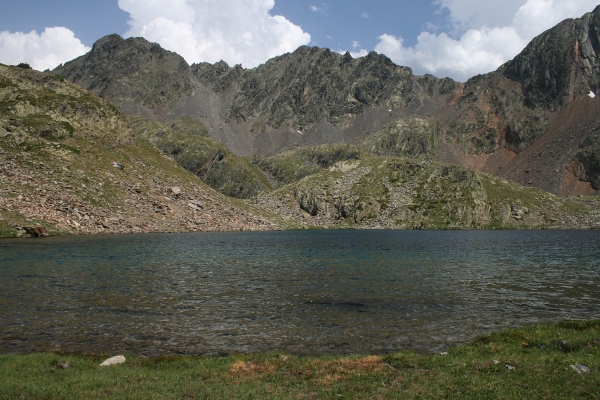
The Portella de Baiau, during our 2008 trip
For a whole month, we'll be mostly disconnected from everything else that
isn't our knee ache, our blisters, the Sun over our heads or where to get
food. It's the first time I leave on a hiking trip as long and tough as this
one, and I feel both uncertainty and eagerness. We've been so busy during the
last few months that we've been unable to train at all for this, and I'm
probably in the worst physical condition in a decade. It's too late
to take care of that now, so we'll try to take good care of our legs and
spine.
In order to get back home in the Mediterranean, we'll have to
be fast, some days joining two stages and skipping a few that we know are not
that interesting (sections over asphalt, etc.). It's hard to make it in just
one month, but we'll try our best. The plan is going to sleep not long after sunset, getting up at dawn, to be able to walk for a decent time before the heat
starts being a handicap and just resting at midday, when the Sun is
strongest.
Of course, this means that I'm missing, yet again, this year's edition
of DebConf in New York City, which is
really sad because I was looking forward hanging around with
Mako,
Mika,
Biella, micah,
Clint and the rest of the
NYC/
Boston gang, but when
the idea of doing a long trip this summer popped up around January, it was
clear DebConf seemed unlikely this year. I hope all of you have a lot of
fun, and see you in a few weeks!
00:14 |
[] |
# |
(comments: 1)
Festa de les Trementinaires
Two weekends ago I went to La Seu d'Urgell again, and early on Saturday
we drove to Tuixent, in the heart of the beautiful Parc Natural del
Cadí-Moixeró, to participate in the
Festa de les Trementinaires
of the Vansa and Tuixent Valleys. Until then, I didn't really know what a
Trementinaire was, so discovering that incredible tradition in place
made it a lot more fun.
A Trementinaire was a woman who, in order to bring some needed extra income
to their family, collected medicinal plants found around the Vansa valley area,
and used them to make remedies, medicines and other valuable goods. The
Trementinaire would then leave their house for a few months every year in order
to walk all over Catalunya, going from town to town selling these remedies.
Some of them were really valuable for the people in the Catalan plain and
coast, and thus were expensive and provided enough money to pay the state's
taxes to the Trementinaire's family. Their name was derived from the
trementina, a substance made from the resin of red pine trees, which
was used to make badges against many kinds of pain and bruises.
The Festa program included lots of different activities, one of the most
interesting being a botanical tour around the Josa village, which gave us a
very practical idea of what plants the trementinaires used and what they were
good for. On Saturday evening, we moved to Sorribes de la Vansa, where we
attended a talk about women in today's valley, and participated on a long
session of traditional Pyrenean song dancing and singing, lead by the amazing
Pep Lizandra. I took my time to become convinced about dancing myself, but it
ended being lots of fun. Many of the songs had strong sexual content, which
makes you wonder why these were acceptable two hundred years ago and are now
so surprising, when not offensive.
El xotis de la relliscada
Eren les dotze ben tocades
quan la nineta va arribar,
duia la trena embolicada,
duia les calces a la mà.
Eren les dotze ben tocades,
el seu xicot la va cridar,
vine Roseta cap a casa,
ai que els meus pares han marxat!
La va abraçar es van petonejar
i la cosa aquí no va parar,
una mà aquí i una altra més enllà
i en Marià no es va poder aturar.
La va abraçar es van petonejar
i la cosa aquí no va parar,
i poc després quan ja anaven llençats
ai la marxa enrere va fallar!
Eren les dotze ben tocades
quan la Roseta va arribar,
duia un vestit de núvia blanca
i un ram de roses a la mà.
Eren les dotze ben tocades
el seu xicot ja era a l’altar
Roseta quina relliscada
haurem de dir sí al capellà
Back in Tuixent, we had dinner with some people we met during the dances
and unfortunately due to the heavy rain we missed the burning of aromatic
plants, but the organization relocated the concert and dance inside the town's
bar so we had our second share of dancing for hours.
On Sunday morning, there was a market of herbal remedies and natural
products and a guided visit to the Museu de les Trementinaires. The museum is
a must see if you visit Tuixent, they have managed to capture the conditions of
life in the valley before this job and tradition extinguished only thirty
years ago, when the last trementinaire left her house to walk all over
Catalunya, or as they said, anar pel món.
Industrialization and a quick and progressive depopulation of the Pyrenean
areas were critical for the survival of a very localized tradition, which now
struggles to not fall in oblivion thanks to the interest of the people of the
Vansa and Tuixent valleys. It's sad to see how such valuable knowledge can
be lost forever when all the women who did it have died...
The Festa de les Trementinaires is something I definitely want to
enjoy again. Hopefully next Spring! If you are around the area, you'll discover
a new world that resembles the Middle Ages, but happened only a few years ago,
and will be welcome by the people of the valley, who show real interest in
passing their culture to the next generation, even if the traditions are not
so much in practice nowdays.
09:50 |
[] |
# |
(comments: 1)
FOSDEM 2009
I'm glad to announce that I'll be again in Brussels for this year's
FOSDEM.
Ivan and I will fly from Zaragoza (!)
on Friday, just on time for the beer event, and come back on Monday
evening. I know
azeem would have not been
happy otherwise!

16:07 |
[] |
# |
(comments: 5)
Iruña
This weekend I had the pleasure of visiting my friend Kike in Iruña, a
city I really like but had not been able to visit in five years. I
spent three days with him, after a really awful Bilman trip during
Friday night.
The first thing that happened on Friday morning was quite unexpected. I
went out, crossed a pair of streets to get to Carlos III, and going past
the corner I found myself surrounded by all kinds of policemen: red, blue,
green and yellow. There were press reporters all over the place, with TV
and photo cameras ready to record something big. What the hell? I looked
around, and there it was: a huge blue sign read Populares de Navarra,
and Mariano Rajoy was seconds away from getting out of the new PP headquarters
in Nafarroa. With a few dozen policemen looking at me in suspicion, and
realising my current hair dress wasn't the most appropriate for that scenario,
I decided to disappear as quickly as possible.
Populares aside, the weekend was really productive. I had a great
time trying to find the places I visited 9 and 5 years ago. It was sad to see
the fantastic Iruñako Gaztetxea turned into an iron building
surrounded by old, traditional houses in the centre of the city. With Kike,
I had enough time to learn more about the origins of Iruña and the three
cities from which it originated, and visit the Ciudadela.
On Saturday, Kike, Ana and I went to have some fun on a snowy day around
Orreaga and had dinner in a small town around the area, maybe Lintzoain? I'm
afraid I forgot due to the mix of basque names in my head. We had dinner
in lo viejo, where I spotted a poster of
Solidari@s con Itoiz for the “Itoitz
hustu arte” campaign, a copy of which I unsuccessfully tried to get in several
places in the city.
On Sunday, Kike and I took a bus to Donosti, and I travelled across the
most beautiful highway I've seen. But of course, that was from my
perspective seated in a bus. I can imagine the Leitzaran highway project must
have been greatly contested by the people of the tiny towns nearby. The spoiled
valleys and views must have been really impressive in the past and seem now
irreversibly ruined by a scar and holes through the mountains.
This was my first visit to Donosti, which held its annual Marathon, and
were lucky to meet our friend Rubén when he was around kilometre 25 of his
race. He managed to finish under 2:50, which was a bit better than what he
aimed for in his first Marathon. Well done! The weather was horrible, and our
visit to La Concha, the old harbour and the Casco Viejo was
short, we were freezing and getting our feet wet.
While I visited Donosti for the first time, Mikel Laboa, one of the most
respected singers in the basque culture, was ebbing away. Laboa's songs always
give me goosebumps, even if I need to read a translation for the basque lyrics.
Many will remember his music from Julio Medem's documentary,
La pelota vasca, featuring
Txoria txori, which has become a symbol of basque culture over the years.
Youtube has quite a few videos, and I'd recommend watching
Txoria txori,
Gure bazterrak,
Lili bat or
Baga biga higa
performed by the Orfeón Donostiarra to name a few.
Mikel Laboa, goian bego.
20:37 |
[] |
# |
(comments: 1)
Turkey
I only start believing I'm visiting some new place when I've finally spent
way too many hours looking at flight websites in an attempt to find a flight
that is slightly cheaper than the only option everyone else is offering you,
and after a few days prices have gone up enough so you give up and end up
buying.
And, two weeks ago, I finally did. Barcelona-Istanbul means
the third chapter of the unplanned saga “Chistmas in Islam”. Two years ago
I started 2007 visiting
Tunisia,
and last year we enjoyed a 10 day trip around the South of
Morocco,
which was absolutely fantastic (and I've still haven't blogged about).
This year I'll be discovering Istanbul, Cappadocia and other parts of
Turkey with Maria. The idea is to try to avoid visiting too many places
in a rush, and follow the good advice of our Moroccan friends, “La prisa
mata, amigo”. We have plenty of days to explore Turkey's secrets, but
I want to be able to enjoy them, and avoid being in a constant hurry.
As always, I'll be glad to get suggestions on “must not miss” places or
things, and advice on how to move around, where to stay, what to do or what
not to do is extremely welcome. I'm totally looking forward to this,
after I missed this years's GUADEC!
16:35 |
[] |
# |
(comments: 4)
Pyrenees and Mallorca
This is the last thing I type before I leave office, pick up my backpack
and drive all the way to Espot, in the Catalan Pyrenees, to hike around the
GR 11 during 7 or 8 days. After that, we'll take a plane to
Mallorca, to spend another week with Jeroni and others in a small town
(I always forget its name).
I'm really looking forward to this, it's been two years since my last
trip to the Pyrenees, and I've been wanting to visit Mallorca for a long
time.
I'm glad I'll be completely incommunicado, so see you on my return on the
18th. Have a nice DebConf,
you lucky ones!
12:04 |
[] |
# |
(comments: 2)
La Ruta del Carrilet
As Josep asks for it every now and then,
and we really enjoyed this trip, it's time to write about the four days we
spent cycling from Ripoll to Girona, through the Ruta del Carrilet,
a Catalan via verda similar to the one
we completed
a year ago.
I spent this year's 9 d'Octubre cycling trip with totally different trip
mates, not related to my triathlon team. The extensive group was formed by
Sabri, Mar, Bàrbara, Carles, Desi, Adela, Núria, Amador and myself. We
started our journey by car from València to Mollet de Mar, where we parked
the cars and take a regional train to Ripoll with our bikes, where the
real journey would start.

Arrival at Ripoll
When we got to Ripoll, it was quite late and dark, but we managed to find
the start of the Ruta del Ferro rail trail which would take us to Sant
Joan de les Abadesses. It was quite cold, but especially really humid, so
we had to think twice before settling on a place to camp and setup our tents.
We had to take special care of covering the bicycles as the air was really wet,
and anything we left uncovered would appear soaking next morning. In part, my
shoes suffered from this.

Early next morning we had breakfast on the wet grass and then started our
way to Sant Joan through a deliciously well equipped and maintained cycling
track, which unfortunately only lasts for 12 kilometres through a splendind
landscape. After having breakfast in the old railway station in Sant Joan, we
abandoned the Ruta del Ferro to take a road to Olot via Sant Pau de
Seguries, where we had to climb a small mountain and then descend through the
Vall de Bianya until we got to Olot.

Sant Joan de les Abadesses' railway station
Asking the locals for the start of the Ruta del Carrilet was
fun due to the strong oriental accent in the area and we sometimes wouldn't get
a word of what we were told. An old man recommended us finding a big park in
the outskirts of the town, where we prepared our entrepans for
lunch, and after a little rest, we started cycling up the Carrilet,
which would take us to Girona in two stages. This Catalan area is of volcanic
origin, and there are several natural parks dedicated to the phenomenon. There
are many mountains covered with forests and impossible peak shapes, which due
to the time of the year were starting to go from green to brown and yellow,
making fantastic colour schemes in the landscape.

Under a green ceiling in Olot
Just after the few first kilometres, the railroad track starts to descend
most of the way, which makes it easy for people who aren't too trained, and
easier to enjoy your way chatting with people while you cycle. As we consumed
the daylight, we came across a parish church party with lots of old and young
people from the nearby town of Sant Miquel de Pineda. Amador and I were lagging
behind a bit at that point, and when we got there, we found the rest of the
group were already off their bikes and either having a curious look over the
party, or directly following suit and dancing like the others. We had a peek
into the small church and also into a small graveyard in the back, where I was
surprised to find the “enemies” of my Catalan grandmother: «Família Matabosch»,
as one of the headstones revealed.

Partying at Sant Miquel de Pineda
As it was getting late, we eventually started off again, but luckily Bàrbara
spotted what seemed a good sleeping place for that night. To the right of the
trail there was a hermitage (devoted to Santa Cecília) up on the hill which,
for bonus points, had a porch with a recently renewed roof which would help
cover ourselves from humidity and rain, as we found soon after starting
cooking dinner.
While the cooks prepared our soup, some others went down to the
Carrilet in order to find out if the next town was close so we could
get some driking water for the dinner. Luckily, Sant Feliu was close enough,
and we found a bar where we got some water... and two bottles of wine, which
made some people back at the hermitage very happy. We were quite tired though,
so we eventually went to sleep after reading some stories from a great tale
book, with the sound of rain hitting the grass outside the porch.
The rain was still with us when we started waking up, so we had breakfast
and packed our stuff very slowly, in an attempt to avoid getting wet. But
rain didn't stop, so we made a few hacks on our bicycle bagpacks to minimise
the amount of rain wetting them. When we were finally ready to set off and
had cycled around 3 kilometres under the light rain, it finally stopped
raining, making the rest of the journey very pleasant.

Sleeping under the porch of Santa Cecília's hermitage
This part of the route is again quite beautiful, with impressive amounts
of green vegetation at both sides of the track. There's a lot of water
presence in the land, which makes the type of trees and bushes quite different
to the ones we are used to find in the Valencian Country.
After going by a few small towns, we arrived in the old railway station
of Amer, hometown of the Puigdemonts. Even if it was a bit early, we
decided to have lunch there, so a few of us went down to the centre of the
town to buy bread and some other details to eat. Being in my friend Josep's
town for the first time, I wanted to visit his
family's bakery, but unfortunately it
is closed on Mondays. We had lunch back at the cute station, and eventually
kept going on our way to Girona. Outside Amer, the Carrilet was
temporarily cut by the road, and there were two possible alternatives: using
the road, with heavy lorry traffic, or diverting through a very steep track
with very hard slopes. Most of the group preferred the road, but Mar, Amador
and I went up that track, which was hard to climb and really fun to descend.
Apparently, Amer locals call those 1.5 kilometres the “Tourmalet”. It's
probably not so bad, though. :)

Amer's railway station
Unfortunately, the Ruta del Carrilet starts getting uglier after
Amer, and as you approach the more industrialised towns near the capital
Girona. The area around Anglès wasn't that fun, with the track continuously
being invaded by cars and other vehicles. Soon after we were in the
farmland area surrounding Girona and its Devesa.
Jonathan was waiting for us in the city, after his two month stay in
Scotland, and we were all happy to meet him. We discarded continuing our
way to the coast, which was the initial plan, and instead dropped our stuff
in the house of one of Adela's friends, and went out to have dinner to a
Wok restaurant, where the poor people running it suffered our
childish behaviour involving the rotating central dish on our table and
custard sucking contests.
Jonathan guided us through the Cathedal and city wall areas of the town
centre, which are impressive, and we climbed all of the wall towers to have
great looks over the dark and quiet city. Eventually, we went to sleep, as
Adela had to leave early, and we had to pack to get our train back to
Barcelona.
Back in Mollet, we cooked our last camping-gaz lunch in the park right next
to the station, before noticing the place stinked of dog poo. After the careful
operation of filling the three cars with 9 bicycles, we were finally on our
way back to València, completing another great cycling journey. If you like
bicycle tourism and can travel to this area in Catalonia, I highly recommend
it, as there's many great places to visit, all of them accessible with
bikes.

Having lunch in Mollet
00:00 |
[] |
# |
(comments: 0)
Page 0 of 4 >>


